More brittle than standard PA12 (lower impact resistance)
Heavier than unfilled PA12
Surface finish remains slightly rough without post-processing
Limited color (whitish/opaque tone)
Not suitable for flexible or snap-fit applications
Higher material cost compared to standard PA12
POLYMER 3D PRINTING
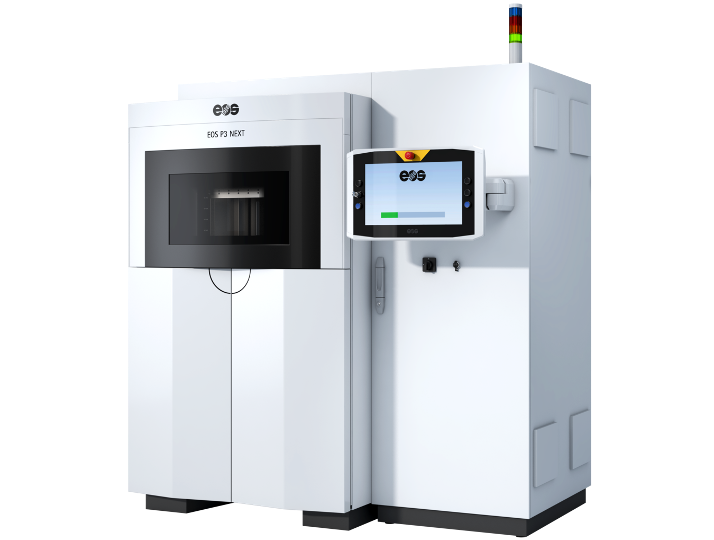
The EOS P 396 is an industrial Selective Laser Sintering (SLS) platform designed for reliable production of polymer parts with consistent quality. With a large build volume (340 × 340 × 600 mm) and a proven process architecture, it is well-suited for serial production, functional components, and stable batch manufacturing workflows.
EOS P 396 KEY SPECIFICATIONS BUILD VOLUME: 340 × 340 × 600 mm LASER TYPE: CO₂ laser; 1 × 70 W SCAN SPEED: up to 6.0 m/s
Polymer Materials
EOS Polymers (SLS / Laser Sintering)
The EOS P 396 is an industrial Selective Laser Sintering (SLS) platform designed for reliable production of polymer parts with consistent quality. With a large build volume (340 × 340 × 600 mm) and a proven process architecture, it is well-suited for serial production, functional components, and stable batch manufacturing workflows.
Excellent mechanical strength and durability
No support structures required (powder acts as support)
Ideal for complex geometries and internal channels
Good chemical and heat resistance (depending on material)
Suitable for functional prototypes and end-use parts
Consistent quality for small-batch production
Wide range of engineering-grade materials (e.g., PA12, PA11, glass-filled, carbon-filled)
Surface is slightly rough and porous without post-processing
Limited color options (typically white/gray unless dyed)
Higher equipment and material cost compared to FDM
Warping may occur in large flat geometries
Requires controlled industrial environment
Post-processing (bead blasting, dyeing) often needed for aesthetic finish
PA 2200 CarbonReduced (PA12, white)
all-purpose PA12 with a balanced mix of strength, stiffness and impact resistance; ~45% lower CO2e; ideal for series production of functional parts, tooling and spare parts.
Reduced carbon footprint compared to standard PA12
Excellent mechanical strength and impact resistance
High dimensional stability and accuracy
Good chemical resistance
Suitable for functional prototypes and end-use parts
Biocompatible grade available for certain applications
Proven material for EOS GmbH SLS systems
Surface finish is slightly rough without post-processing
Limited to white color (can be dyed after printing)
Not flexible compared to elastomer materials
Moderate heat resistance compared to high-performance polymers
Requires industrial SLS equipment
Higher cost than standard FDM filaments
ALM PA 950 HD (PA12, grey/black)
improved feature resolution and surface quality; consistent reusability for repeatable results; for load-bearing parts requiring a balance of strength and flexibility
High stiffness and improved mechanical strength
Excellent dimensional stability
Good heat resistance compared to standard PA12
Suitable for functional and load-bearing parts
Good surface resolution for SLS applications
Available in grey/black color (better visual finish vs. white powders)
Reliable performance in industrial SLS systems
Lower impact resistance compared to more ductile PA12 grades
Surface still requires post-processing for smooth finish
Limited color range
Not flexible (rigid material)
Higher cost compared to standard PA12 powders
Requires industrial SLS equipment and controlled environment
PA 3200 GF (PA12, glass-bead filled, whitish)
increased stiffness and wear resistance with improved temperature capability; for housings/covers, abrasion-resistant parts, and forming tooling
Increased stiffness and rigidity due to glass-bead reinforcement
Excellent dimensional stability and reduced warping
Improved heat deflection temperature compared to unfilled PA12
Low shrinkage during printing
Good chemical resistance
Ideal for housings, fixtures, jigs, and mechanically stable components
Suitable for industrial SLS production environments
Alumide (PA12, aluminium-filled, metallic grey)
higher stiffness and easier post-processing; limited thermal conductivity; for design parts, manufacturing aids and small-series casting molds.
Attractive metallic appearance (natural grey finish)
Higher stiffness compared to standard PA12
Good thermal resistance
Excellent dimensional stability
Reduced warping during printing
Suitable for aesthetic prototypes and design models
Ideal for housings, covers, and visually exposed parts
More brittle than standard PA12
Lower impact resistance
Surface is slightly porous and requires sealing for certain applications
Heavier than unfilled PA12
Limited color options (metallic grey only)
Not suitable for highly dynamic or load-bearing mechanical parts
PA 1100 (PA11, white)
high ductility and impact toughness; bio-based; for impact-loaded functional parts where flexibility is important.
Bio-based material (derived from castor oil)
Excellent ductility and impact resistance
Higher elongation at break compared to PA12
Good fatigue resistance (ideal for snap-fits and living hinges)
Strong chemical resistance
Suitable for functional, dynamic, and load-bearing parts
Good surface quality for SLS applications
Slightly lower stiffness compared to PA12
Limited to white/natural color (can be dyed)
Surface remains slightly porous without post-processing
Higher material cost compared to standard PA12
Moderate heat resistance compared to high-performance polymers
Requires industrial SLS equipment
PEKK 100 (PEKK, beige)
high strength and toughness with high dielectric strength (fully insulating); inherently FR; strong chemical/oil resistance; suitable for replacing PA6/PA66 compounds or metal in demanding environments.
Very high temperature resistance (suitable for demanding thermal environments)
Excellent mechanical strength and stiffness
Outstanding chemical resistance
Superior flame retardancy and low smoke emission
High dimensional stability under load
Suitable for aerospace, automotive, and high-performance industrial applications
Can replace certain metal components to reduce weight
Significantly higher material cost compared to PA-based polymers
Requires high-temperature industrial SLS systems
More challenging processing conditions
Surface requires post-processing for smooth aesthetic finish
Limited color availability (natural beige tone)
Not suitable for low-cost prototyping applications
EOS TPU 1301 (TPU, white)
high elasticity, hydrolysis resistance and strong UV stability; for protective gear, soles, tubes, bellows, seals/gaskets
High elasticity and flexibility (rubber-like behavior)
Excellent abrasion and wear resistance
Good tear strength
Strong chemical resistance to oils and greases
Consistent mechanical properties in SLS production
Ideal for seals, gaskets, flexible connectors, and protective covers
Reliable performance in EOS GmbH SLS systems
Lower stiffness compared to rigid PA materials
Limited temperature resistance compared to high-performance polymers
Surface is slightly porous without sealing
Limited color (white; dyeing options may be restricted)
Not suitable for high structural load-bearing parts
Requires industrial SLS equipment and controlled processing environment
ALM TPE 410 (TPE, white)
lightweight with high rebound and a soft, “velvety” feel; for soles, cushioning, orthotics, liners/padding.
Flexible, rubber-like material with good elasticity
High elongation at break
Good impact absorption properties
Suitable for snap-fit and soft-touch applications
Good chemical resistance to oils and greases
Consistent processing in industrial SLS systems
Ideal for seals, gaskets, grips, and protective components
Lower tensile strength compared to rigid PA materials
Limited heat resistance
Surface remains slightly porous without post-processing
Limited color availability (white)
Not suitable for high structural or load-bearing applications
Requires industrial SLS equipment and controlled environment
HT-23 (PEKK, carbon-fiber reinforced, grey)
very high strength/stiffness and elevated temperature capability; limited electrical conductivity; inherently FR (aircraft/rail standards); for “metal replacement” lightweight structural parts.
Extremely high mechanical strength and stiffness due to carbon fiber reinforcement
Excellent thermal resistance and performance in high-temperature environments
Outstanding chemical resistance
Very high dimensional stability and low deformation under load
Lightweight alternative to metal components
Suitable for aerospace, high-performance engineering, and advanced industrial applications
Very high material and production cost
Requires specialized high-temperature SLS printing equipment
More brittle than unreinforced PEKK polymers
Surface is rough and usually requires post-processing for smooth finish
Limited color options (typically grey/black tones)
Not suitable for flexible or impact-absorbing applications
PrimePart FR / PA 2241 FR (white)
flame-retardant material qualified by Airbus; halogen-containing FR; for aircraft interior components.
Flame-retardant formulation — designed for improved fire safety performance
Good mechanical strength and stiffness
Excellent dimensional stability and accuracy
Suitable for functional prototypes and production parts with safety requirements
Consistent processing in industrial SLS systems
White color provides a clean aesthetic and can be dyed post-print
Surface is slightly rough and porous without post-processing
Higher material cost due to flame-retardant additives
Limited color options (primarily white/neutral tones)
Slightly lower impact resistance than some standard PA12 grades
Requires industrial SLS equipment
Heat resistance is moderate compared to high-performance high-temp polymers
PA 2210 FR (PA12, flame-retardant, white)
FR material with UL Blue Card, halogen-free; for aircraft/rail interiors and electronics.
Flame-retardant properties — enhanced fire safety for regulated applications
Good mechanical strength and stiffness
Excellent dimensional stability and accuracy
Suitable for functional prototypes and end-use parts with safety requirements
Consistent performance in industrial SLS systems
White color suitable for visible parts and can be dyed after printing
Surface is slightly rough and porous without post-processing
Higher cost than standard PA12 due to flame-retardant additives
Limited color options (primarily white/neutral tones)
Slightly reduced impact resistance versus standard PA12
Moderate heat resistance compared to high-temperature polymers
Requires industrial SLS equipment and controlled processing conditions
PA 2201 (PA12, natural)
“natural” PA12 targeted for biocompatible/medical applications; for functional parts.
Good overall mechanical strength and stiffness
Excellent dimensional stability and accuracy
Well-proven performance in SLS manufacturing
Versatile for functional prototypes and end-use parts
Natural (off-white) color suitable for dyeing and finishing
Relatively cost-effective compared to specialty PA12 variants
Broad material support and availability in industrial SLS systems
Surface is slightly rough and porous without post-processing
Limited inherent aesthetic finish (often requires bead blasting or polishing)
Not flexible — rigid material typical of PA12
Moderate heat resistance compared to high-temp polymers
Color range limited to natural/off-white unless post-colored
Requires industrial SLS equipment and controlled processing environment
From Idea to Serial Product — Made In Israel
Comapny address
Nahum Het 9, Tirat Carmel, Israel
Social
© 2025 NOVAKRON. All rights reserved