METAL 3D PRINTING IN iSRAEL
METAL ADDITIVE MANUFACTuRING
Additive Manufacturing Technologies: 3D Printing, Rapid Prototyping, and Direct Digital Manufacturing (2nd ed.). Springer.
Gibson, I., Rosen, D. W., & Stucker, B. (2015).
involves the layer-by-layer consolidation of metal powder or wire feedstock to fabricate fully dense, functional metal parts. These processes typically rely on high-energy heat sources such as lasers or electron beams
From Complex Geometry to Mass Production
At NOVAKRON, metal 3D printing is not just about unique components — it’s about industrial-scale production of high-precision metal parts. We specialize in scaling up — moving from prototypes to full-scale serial manufacturing — with full control over repeatability, quality, and cost-efficiency.
Read more
Using Laser Powder Bed Fusion (LPBF) technology, we produce single-piece components with complex geometries that are impossible to make using traditional methods — and we do it at volume.
With over 10 years of hands-on experience in additive manufacturing, our team helps customers:
Reduce time-to-market
Minimize assembly through part consolidation and optimization
Lightweight structures without compromising strength
Integrate advanced functionality into single components
Build scalable AM production workflows ready for serial output
Our solutions are trusted by aerospace, defense, and automotive sectors across Israel.
Feedstock selected for mechanical, thermal, and chemical properties that meet final part requirements
Functional parts with maximum geometric complexity and true form integration
Flexible solutions for every stage — from one-off prototypes to full-scale mass production
From standard AM finishing to tailored, part-specific treatments
Validating both material performance and geometric precision.
Direct Metal Laser Sintering (DMLS) /
Laser Powder Bed Fusion (LPBF)
Process parameter optimization for direct metal laser sintering (DMLS), Ph.D. thesis, National University of Singapore, Singapore.
Yu, N., (2005)
is an additive manufacturing technique; used to 3D print metal parts with powdered metal or alloys being the raw material.
Read more
It belongs to the family of laser powder bed fusion technologies; which involve a precise high wattage laser selectively sintering the powdered metal such that the particles melt and fuse together to give rise to the final product based on the computer aided design (CAD) model. Fully functional complex parts that cannot be manufactured using conventional methods can be obtained using DMLS/LPBF with high accuracy, superior properties and faster turnaround times in manufacturing.
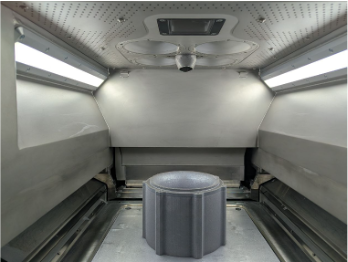
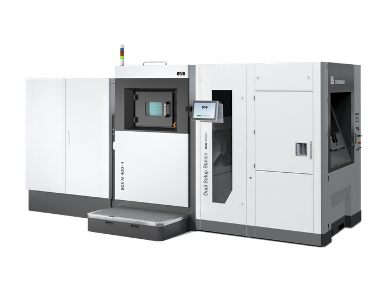
The EOS M 400-4 system, equipped with multiple lasers (four 400-watt fiber lasers working in parallel) and an advanced optical system, offers a large build volume (400 × 400 × 400 mm) and high productivity, making it suitable for serial production of metal parts in aerospace and automotive sectors
EOS M 400-4 Key Specifications Build Volume: 400 × 400 × 400 mm Laser Type: Yb-fiber laser; 4 × 400 W
Read more
Optics: 4 F-theta lenses; 4 high-speed scanners
Scan Speed: up to 7,000 mm/s
Focus Diameter: approx. 90 μm
Power Supply: 3 × 50 A
Power Consumption: max. 45.0 kW / typical 22.0 kW
Compressed Air Supply: 7 bar; 20 m³/h
Additive Manufacturing Technologies: 3D Printing, Rapid Prototyping and Direct Digital Manufacturing, Gibson et al., Springer, 2015.
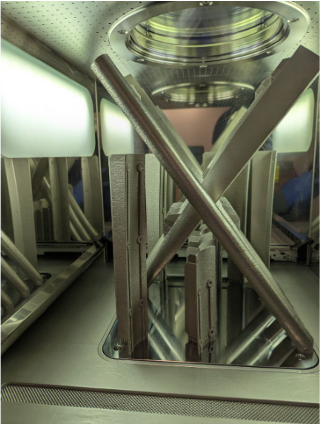
The Renishaw RenAM 500Q is a high-productivity LPBF system with a build volume of 250 × 250 × 350 mm and four lasers, each up to 500 W. Designed for industrial-scale metal AM, it offers build rates of up to 150 cm³/h depending on material and process parameters. The system allows precise control of mechanical properties and delivers much higher throughput than single-laser systems, making it ideal for scalable, cost-efficient metal part production.
RenAM 500Q ULTRA Key Specifications Build Volume: 250 × 250 × 250 mm Laser Type: Yb-fiber laser; 4 × 500 W
Read more
Optics: Dynamic focusing; beam focus diameter 80 μm; scan speed up to 10 m/s
Build Rate: Up to 150 cm³/h
Powder Layer Thickness: 30–120 μm
Power Supply: 3 × 50 A
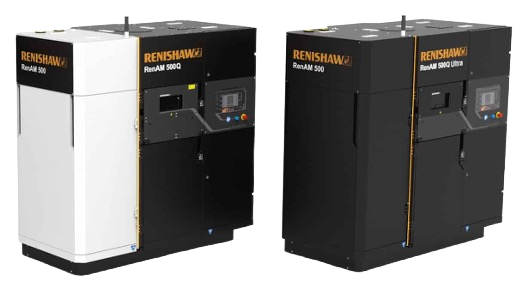
Wong, H., Dawson, K., Ravi, G.A. et al. Multi-Laser Powder Bed Fusion Benchmarking-Initial Trials with Inconel 625. Int J Adv Manuf Technol 105, 2891–2906 (2019).
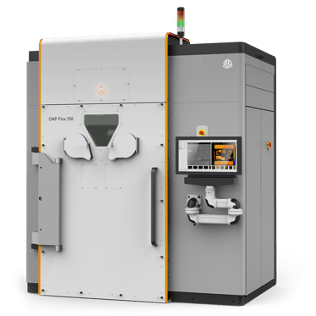
DMP Flex 350 Triple compact metal Additive Manufacturing machine, three-laser machine includes the company’s vacuum chamber design and extends its novel Removable Print Module (RPM) concept by supporting two distinct RPM modules with different build volumes. This includes a new RPM with a build of 350 x 350 x 350 mm and a standard RPM with a build volume of 275 x 275 x 420 mm.
DMP Flex 350 Triple Key Specifications Build Volume: 350 x 350 x 350 mm / 275 x 275 x 420 Laser Type: 3 x 500W Fiber laser
Read more
Minimum Feature Size 200 μm
Powder Layer Thickness: 5–90 μm
Build Platform Heating: 250°C
Typical Accuracy ± 0.1-0.2% with ± 100 μm minimum
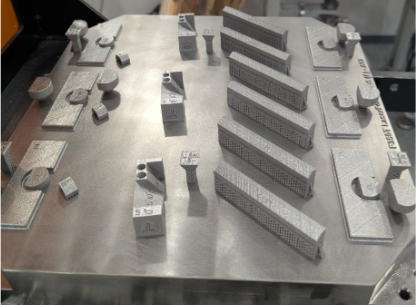
Wong, H., Dawson, K., Ravi, G.A. et al. Multi-Laser Powder Bed Fusion Benchmarking-Initial Trials with Inconel 625. Int J Adv Manuf Technol 105, 2891–2906 (2019).
Metal Materials
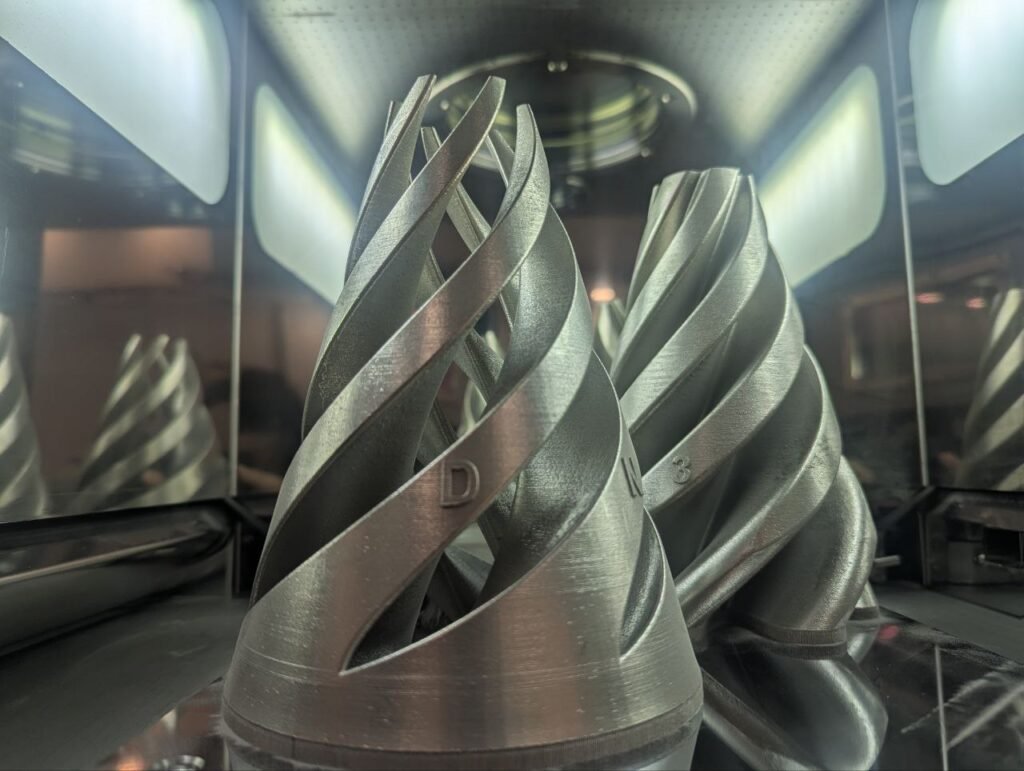
Aluminium AlSi10Mg
AlSi10Mg is an aluminum alloy that enables the production of lightweight parts with good mechanical properties and high thermal conductivity. It is widely used in aerospace, automotive, and industrial applications.
Lightweight material
Good mechanical properties
High thermal conductivity
Good corrosion resistance
Post-treatment possible
Lower strength compared to steel alloys
Not suitable for high-temperature applications
Limited wear resistance
AL5X1
Al5X1 is an aluminum alloy developed for additive manufacturing, offering high strength combined with good corrosion resistance and thermal stability. It is suitable for lightweight structural and industrial applications.
High strength aluminum alloy
Good corrosion resistance
Lightweight material
Good thermal stability
Post-treatment possible
Lower strength compared to steel alloys
Not suitable for extreme high-temperature applications
Limited wear resistance
Ti64
Ti64 (Ti-6Al-4V) is a titanium alloy known for its excellent strength-to-weight ratio, corrosion resistance, and biocompatibility. It is widely used in aerospace, medical, and high-performance industrial applications.
Excellent strength-to-weight ratio
High corrosion resistance
Good fatigue performance
Suitable for post-treatment
High thermal stability
High material cost
Difficult machining compared to aluminum
Limited thermal conductivity
Inconel 718
Inconel 718 is a nickel-based superalloy known for its excellent mechanical strength, corrosion resistance, and stability at high temperatures. It is widely used in aerospace, energy, and high-performance industrial applications.
Excellent mechanical strength
High-temperature resistance
Good corrosion and oxidation resistance
Suitable for post-treatment
Good fatigue and creep resistance
High material cost
Difficult post-processing and machining
Not suitable for medical or food-contact applications
Hastelloy HX
Hastelloy HX is a nickel-based alloy designed for high-temperature applications requiring excellent oxidation resistance and structural stability. It is commonly used in aerospace, gas turbine, and energy industries.
Excellent oxidation resistance at high temperatures
Good mechanical strength
High thermal stability
Suitable for post-treatment
Good resistance to thermal fatigue
High material cost
Difficult machining and post-processing
Not suitable for medical or food-contact applications
Invar 36
Invar 36 is a nickel–iron alloy known for its exceptionally low coefficient of thermal expansion. It is widely used in applications where dimensional stability under temperature variations is critical.
Extremely low thermal expansion
Excellent dimensional stability
Good mechanical properties
Suitable for post-treatment
Stable performance over a wide temperature range
Limited corrosion resistance
Lower strength compared to high-performance alloys
Higher material cost than standard steels
316L
316L is an austenitic stainless steel known for its excellent corrosion resistance and good mechanical properties. It is widely used in industrial, medical, and food-related applications.
Excellent corrosion resistance
Good mechanical properties
Non-magnetic
Suitable for post-treatment
Good surface quality
Lower strength compared to hardened steels
Limited wear resistance
Not suitable for high-temperature structural applications
17-4PH
17-4PH is a precipitation-hardening stainless steel offering a combination of high strength, hardness, and good corrosion resistance. It is commonly used in aerospace, automotive, and industrial applications.
High mechanical strength
Good corrosion resistance
Heat treatable for enhanced properties
Suitable for post-treatment
Good dimensional stability
Reduced corrosion resistance compared to austenitic stainless steels
Requires heat treatment to achieve final properties
Limited suitability for medical or food-contact applications
Maraging Steel MS1
Maraging Steel MS1 is a high-performance steel known for its ultra-high strength, excellent toughness, and dimensional stability. It is widely used for tooling, aerospace, and demanding industrial applications.
Extremely high mechanical strength
Excellent toughness
Good dimensional stability
Suitable for post-treatment (aging)
High performance under mechanical loads
Low corrosion resistance
Requires heat treatment to achieve final properties
High material cost